Cub Scouts Learn 4 Songs in Half an Hour

Cub Scouts Learn 4 Songs in Half an Hour

Would you like to know how to learn the ukulele fast?

Cub Scouts Learn Four Ukulele Songs Fast!

Recently, I taught a group of cub scouts at their den meeting. The Cubs sounded great and had a lot of fun. They learned two chords and four songs: Are You Sleeping; Row, Row, Row Your Boat; Three Blind Mice and Ghost of John. The children especially liked Ghost of John, because they had sung it in music class. They also liked the sound of the A Minor chord.

All of this material is included with purchase of our book 21 Songs in 6 Days: Learn Ukulele the Easy WayWhen you purchase the book, either in paperback or electronic format, you can sign up for resources here at ukulele.io that include video lessons and the snappy accompaniments. What’s even better is that you too can sound good right away, just like the Cub Scouts.

With the snappy .mp3 accompaniment, all the Cubs could feel the beat and learn the basic strumming patterns.It was amazing how well the children could all play and sing together with the help of a little technology.

Are you struggling with strumming?

With our book and course, you’ll become a fluent 3-chord strummer.

Get your copy now!

Do I need a ukulele strap?

Do I need a ukulele strap?

do I need a strap?

You may be wondering, do I need a ukulele strap? My experience is that having one really helps! When I started to learn more complicated left and right hand patterns, I definitely felt I needed one. The strap keeps the ukulele in place, which makes it easier to move around on the instrument.

What type of strap should you get? I got a ukulele thong, because I did not have an end button on my soprano ukulele. The thong has a small hook that hooks into the sound hole of your ukulele. They can be hard to find. Classical guitarists also use these types of straps, so the Guitar Center can order one for you.

I’ve been working on holiday songs to sing and teach at school: “Let It Snow” and “Winter Wonderland.” Both songs have a lot of changes and fairly complicated strumming patterns. I also want to include a ukulele solo section with finger picking in the main part of each song.

Well, I’ve learned where some of the higher notes are on the ukulele, some bar chords and some movable chords. I’ve also learned some more complicated strumming patterns with chunking and coordinating all of these techniques with singing. I practice at home with an accompaniment track I created through Band In A Box, and have gradually gotten better at the songs.

So, do I need a ukulele strap?

Yes, you do. I would recommend a strap for a ukulele. Also, I play and teach violin. I would compare the strap to using a shoulder rest on the violin or viola. Without one, you can still play, but it is difficult to shift or do vibrato, unless you are already quite accomplished. Why not make it easier for yourself, and buy a ukulele strap? Check this page for our recommendations on straps and other ukulele accessories.

Are you struggling with strumming?

With our book and course, you’ll become a fluent 3-chord strummer.

Get your copy now!

Can You REALLY Learn Ukulele in 20 Hours?

Can You REALLY Learn Ukulele in 20 Hours?

In his book, The First 20 Hours: How to Learn ANYTHING Fast, Josh Kaufman describes how he mastered and performed a four-chord song on the ukulele in a very short time. I forget whether it was one week or two weeks, but his performance definitely fell under the heading ‘rapid skill acquisition’, which is his phrase for learning new things quickly.

But although Josh can learn a four chord song really fast, can you?

Well my answer is unfortunately rather vague: it depends. It depends on your previous musical background and your practicing skills. But I think the more important question is, why not go ahead and TRY to learn some ukulele in 20 hours?  What have you got to lose other than some free time?

One thing Josh is definitely right about is that it matters a lot exactly how you spend your 20 hours of practicing.

Josh certainly has learned more skills rapidly than I have. But I have spent thousands more hours watching beginners tackle new musical skills than he has. So, I thought I’d offer my personal take on how his principles of rapid skill acquisition how apply to learning ukulele.learn ukulele fast with the right information

I’ve organized my thoughts by using some of the principles Josh presents in his book. You might enjoy reading the book as you start working on ukulele. But DON’T compare your progress to his. Josh was anything but a musical beginner when he started learning ukulele. He already had experience singing in a choir. He also has some practice with the ukulele’s two handed strum/chord coordination. Because he had previously played some guitar.

So here goes: key concepts numbers one and two.

1. Make time to practice

The time you spend practicing ukulele must come from somewhere else in your schedule. You will not “find” time in a big pile under a bush somewhere. We all are allotted 24 hours per day. Some you must dedicate to work, and some to caring for yourself or loved ones. The hours that remain are what you have left to learn the ukulele. You must take a hard look at your schedule. And see if you can eliminate other activities that are less important to you than learning ukulele.

Another important fact about learning something new is the more time you spend working on it each day, the fewer days it will take to learn. And the faster you get good at ukulele, the more you will enjoy it. The enjoyment will make it easier to choose ukulele practice over, say, watching TV or cruising Facebook.

2. Make starting easy

If possible, create a space where you can keep your gear set up so that you can get started quickly when practice time rolls around. Failing that, try to store your gear to minimize setup time. Concert pianist Robert Henry likes to stress the importance of what can be accomplished in short bursts of practice (2-3 minutes). But if you have to spend 20 minutes finding your ukulele and folding the laundry on top of it before you can begin, you might burn up all your available practice time before you play a note.

My sister and I think how you practice is so crucial to learning that we have included many practice tips in our book 21 Songs in 6 Days. When you’re just getting started with music, learning HOW to practice is probably the most important thing to learn. So we guide you step by step on how to master all the crucial basic skills in ukulele playing such as changing chords while you maintain a steady strum.

What do you think? Have you been able to make quick progress on the ukulele or other musical instruments? What seemed to be the key factors for you?

Are you struggling with strumming?

With our book and course, you’ll become a fluent 3-chord strummer.

Get your copy now!

Ukulele Practicing Tips: Plan Ahead to Learn Ukulele Fast

Ukulele Practicing Tips: Plan Ahead to Learn Ukulele Fast

Here are more ukulele practicing tips to learn how to play the ukulele fast.

In my last post, “Can You REALLY Learn Ukulele in 20 Hours?”, I talked about some of the principles of ‘rapid skill acquisition’ presented by Josh Kaufman in his recent book, The First 20 Hours: How to Learn ANYTHING Fast.  I looked at how important it is to create time to practice by weeding out other activities that are less important, and the importance of making it easy to get started practicing.

In today’s post, let’s look at two more key ideas about learning something fast, or at least in the most efficient way possible.

To Learn Ukulele Fast, Plan Ahead to Block Distractions

After you’re done creating a place where you can store your ukulele and associated gear for easy access, put some attention on how to block 20834331212_fc5cfae9ac_ndistractions before they start. It’s best if your space can be free of noise (if that distracts you), and requests for attention from family, pets, and electronic family/pets such as your smart phone, tablet, or computer.

Since the ukulele is portable, maybe your practice space can be physically distant from potential distractors. If the distracting items have on/off switches or volume controls, use them! Unfortunately this doesn’t work on cats, but I do have Clare the Cat trained to curl up and sleep on the chair next to me when I am practicing. When necessary, I reinforce training with additional dried bonito flakes. See Clare in action with ukulele playing here.

Maybe you can do your practicing when family members are away, concentrating on their own activities, or asleep.  You probably can’t train them with dried bonito flakes, but there might be other “treats” that can be negotiated. All of this planning will help you learn ukulele fast.

Plan How to Overcome Emotional Blocks

In my almost 40 years of piano teaching experience, adult music learners often have unrealistically high expectations of how fast they ‘should’ progress. (Children are used to beginning new skills and tend to be less judgmental.) Adults also sabotage themselves by comparing themselves to others (sometimes real, more often imaginary), who are of course doing better than they are.

Finally, everyone has a different learning style and background, so things that are easy for one person may be difficult for another. As a teacher, I can definitely say I have NEVER had a student for whom everything is easy. Even the most brilliant players had to work hard at something, and the ones that improve the most quickly are those who work the hardest and who are the most patient and positive.

Tell the negative voice in your head to be quiet so you can concentrate. It is irrelevant whether you are learning faster or slower than someone else, because learning is not a race: hopefully it never ends, and you’re not in it for the prize money anyway.

Sometimes it is helpful to find a supportive other; maybe there is a friend or family member who can cheer you on. There also are a lot of great ukulele groups on Facebook where people encourage each other and ask for help and advice.

All of these tips will help you learn ukulele fast. And I’d love to hear from you. Which ukulele practicing tips did you try and which ones work the best for you? What is your practice space like? What do you like about it? Have you had to overcome any emotional blocks on your path to ukulele ninja-ism? How did you do it? Any tips for others?

Do you want to learn how to practice better?

In our “Practice Makes Permanent Program,” we’ll teach you how to practice. You’ll get an online membership that gives you specific practice guidance on how to improve at your ukulele.

Sign Up Today!

Playing the Ukulele on a Lake Michigan Beach

Playing the Ukulele on a Lake Michigan Beach

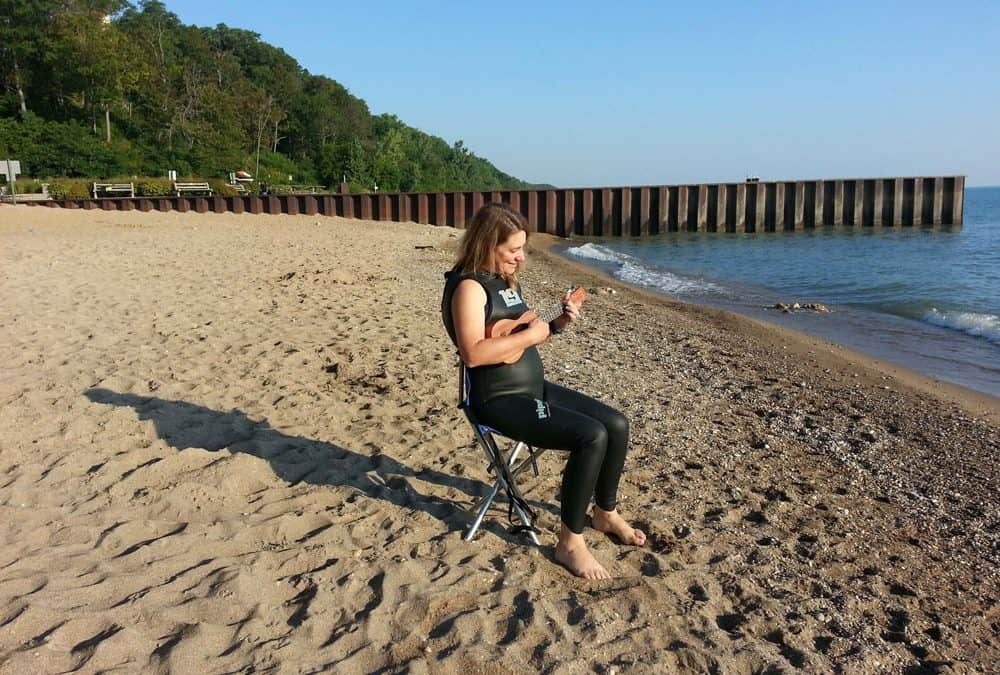
Playing the ukulele brings joy and peace of mind so you can play it anywhere you want, even at the beach on a cold weather day. Here I am enjoying the day at the beach. And also having fun with my ukulele.

Our water is colder than in Hawaii, but it is still fun to play the uke before a long swim in the lake! Our water is COLD, hence the wetsuit!

In Chicago, we are on Lake Michigan. It doesn’t smell like the ocean, but the lake is huge. You cannot see land on the other side.

Over the years many ships have been wrecked in the Great Lakes when they have run aground during big storms. It can be peaceful to sit by Lake Michigan, but it can also be a place where there are great storms and waves. I love playing my ukulele outside and communing with nature.

What about you? When is your favorite time to play ukulele?

If you’re a beginner looking to learn how to play the ukulele, check out our bestselling book, 21 Songs in 6 Days!

Are you struggling with strumming?

With our book and course, you’ll become a fluent 3-chord strummer.

Get your copy now!

Ukulele for Beginners: Chords first, or reading music?

Ukulele for Beginners: Chords first, or reading music?

Should you learn ukulele chords first or should you start out by mastering music notation?

Learning musical notation or ukulele chords?

What should come first?

This is actually a very important question for music teachers and their students alike.

As a music teacher, do you start by teaching your class music notation and then work your way up to the chords or do you reverse that order?

In an attempt to give a precise answer to this difficult problem, I present a two-sided argument below as a response to a comment from one of our members. Jenny gives her views and through the discussion, the pros and cons of each of the two approaches have been clearly highlighted.

I am curious about how you view learning to read notes/music on ukulele.

This fall I will be starting a first-time ukulele class at one school in which I teach, and I chose to use James Hill’s “Ukulele in the Classroom” because I was quite impressed by the Langley BC school’s program, of which Hill is an alumnus.

A new librarian sparked interest in ukulele here a year ago, and I have enjoyed taking it up, but we have quite a difference of opinion about how one should learn the uke. I’m a school elementary music teacher, used to teach band, I play trombone and classical guitar plus a lot of instruments some, and I think the classic approach — learning to read music on the instrument, then learning chords, etc. — is the most pedagogically honest approach.

I understand that starting with chords might be more “fun”, but I still think people should learn an instrument from the ground up, so to speak. You both have Masters in Piano; what did you learn first on piano, notes or chords? Why would a fretted instrument necessarily be any different? I await your argument! Who knows; I might change my mind!

Yes, I believe music reading is important, but it is more important to get people excited about music and playing instruments first.  Our approach builds rhythmic and aural awareness before music reading is introduced.

I am an elementary general music teacher and orchestra director. I have observed that in one 30-minute class per week, students can learn how music notation works (note identification treble clef and rhythmic reading) but not much more.

Truly fluent music reading comes after several years of practicing an instrument. I expect my 5th-grade orchestra students to be reading music well by the end of two years of concentrated practice, but not my general music students, who don’t have instruments at home and as much desire to learn notation.

Music Notation

I, too, have been impressed with James Hill’s materials, but as a general rule, I see Canadian musical expectations to be more rigorous than ours here in the United States.  I have observed these rigorous expectations with bowed stringed instruments and piano as well.

Still, I do want my general music students reading some music. I will keep their notation skills going with rhythmic and note flashcards, with these skills to be applied on Orff xylophones. I have observed that many fine guitarists read tab and I have seen ukulele written out with tab.

Motivated Students

For my more motivated ukulele students, I write tab melodies that have regular music notation above the tab.  I use a program called TablEdit for that. Ukulele and guitar notations are pretty complicated to read with standard notation because it resembles what pianists read, but on only one staff.

As an aside, my son learned guitar with tab, French horn and violin with standard music notation. The tab introduction did not seem to hurt him and he became a fine sight reader on all three instruments.

Music is taught worldwide with more basis on using one’s ear and imitating a teacher.  I think in a large class situation, one is more likely to get students excited and wanting to learn music if you start this way.

Hope this helps explain our philosophy.

Comment from a Customer:

Hi Jenny,

Thank you for the most lucid answer. I have seen to the notes/chords/tab etc. question! And I must respect your approach because you seem to be getting kids to be enthusiastic and also because you have paid your own dues as a reader of music. I hope to get to the “fun” stuff quickly while still doing a notes-first approach. I know I’m old-school about it; probably because I Am old!

In the ’60s, in high school, I was a trombone player, got a book and taught myself guitar. The book, I remember, was by Nick Manaloff. It was like the Mel Bay Modern Guitar Method. You learned notes and then learned how C E G makes a C chord, and on from there. So when you played a chord, you knew what was in it.

I’ve had some experience trying to teach note-reading to guitar players who only know chords. It has been, almost across the board, very difficult for them, even though they say they want to learn. I think it is, in their minds, going backward or worse. When they can play chords and hear nice sounds & that is enough for them, why bother with notes?

For me, it boils down to being able to communicate, to having a common musical vocabulary. People such as the ones in our uke group who know only chords, only understand things like “put your finger here, then here, etc.” It becomes quite an impediment to trying to do more interesting things instrumentally.  But I will be keeping your approach & your discussion points in mind! And trying to find a happy medium ground.

Thank you, and have a good year!

Conclusion

Music is universal, something all of us can identify with, not just the ones who are music majors or professionals. Most people or students want (and indeed need) to feel excited about learning a new instrument. Employing a chords first approach ensures that they can do away with all the complexities of having to learn music notation first and cut right through to the great fun of making music.

Beginners can start playing their favorite songs from the very first day. This ensures that  your students maintain their interest in the instrument. And from there they can advance to learn music notation if they so wish. This is the approach we take in all our books.

Happy strumming!

Are you struggling with strumming?

With our book and course, you’ll become a fluent 3-chord strummer.

Get your copy now!