Ukulele Capos

Ukulele Capos

What is a capo?
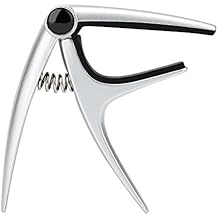
ukulele caposIt’s a rubber-covered bar that clamps to your ukulele’s neck and holds down the strings. The capo shortens the strings’ playable length which means their pitches sound higher. Ukulele capos are especially suited to be used with the ukulele.

Use a capo (short for capotasto, which means ‘head of the fretboard’) when you want an easy way to play a piece you already know in a different key. It’s much easier to clip a capo on the fretboard than it is to re-learn your song in a new key.

Different stringed instruments have different capos.

Check this page if you’re looking to purchase a capo or other ukulele accessories.

Why use a capo?

Some people think using a capo is lazy. Others think it is cheating. These folks would advise you to invest the time to learn your song in the new key. While this view makes sense, don’t throw away your capo yet!

Let’s say your favorite singer asks you to play with her in a different key at the very last minute….say just before you are about to go out on stage in front of hundreds of people. At that moment you will be very grateful to your trusty capo.

For beginners, using the capo now and then to transpose is fine. But as you improve, learn to play in different keys without using the capo.  Learning to transpose a song will develop your musical ear, understanding and chops!

Barre Chords and Capos

Using a finger to stop all four of the ukulele’s strings is called a barre chord.  Using your first finger as a barre across the strings has the same effect on string’s pitches as using a capo.

ukulele capos

Barre chords are easier to learn on ukulele than they are on guitar because the ukulele’s neck is smaller than the guitar’s. But simply clamping a capo across the strings is even easier than teaching your finger to stop all four strings.

Using a capo can also help when you are playing a song that is in a ukulele unfriendly key. James Hill uses a capo when he accompanies Anne Janelle on the song “A Good Lover”. That’s because the song is in A Major which is a comfortable key for the cello, but an uncomfortable key for the ukulele.

How to Use a Ukulele Capo

First, the music alphabet

Using the capo is as simple as learning the music alphabet. The notes in the music alphabet go in this order.

A A# B C C# D D# E F F# G G# A A#….

Each letter in the music alphabet is a half step or semitone from the one before or after.  Each ukulele fret is also a half step or semitone. Notice that there are no notes between B and C or between E and F.  Sad but true.

One other thing to know about the music alphabet is that on the ukulele, any sharp could also be spelled as a flat of the next music letter. So,

A# = Bb

C# = Db

D# = Eb

F# = Gb

G# = Ab

Next, figure out where to put the capo

Standard ukulele tuning is called ‘C tuning’. Clamp the capo on the fret that matches the tuning (or key signature) you would like to play in. Then just play the chords or pitches from the key you know.

Below is a simple illustration of the tone (whole step) and semitone (half step) pattern in the key of C major in case anyone is wondering what is going on.

ukulele capos- major scale

ukulele caposPlacing the capo on the first fret of the ukulele moves all the strings a half step (semitone) higher. If the capo is placed on the second fret, the strings move a whole step (tone) higher. And when you place the capo on the third fret, the strings move one and a half steps (tones) higher and so on.

Blow by blow

Here’s a blow by blow:

1st fret – changes your uke to C# tuning. C becomes C#, D becomes D#, E becomes F etc.

2nd fret – changes your uke to D tuning. C becomes D, D becomes E, E becomes F# etc.

3rd fret – changes your uke to Eb or D# tuning. C becomes Eb , D becomes F, E becomes G etc.

4th fret – changes your uke to E tuning. C becomes E, D becomes F#, E becomes G# etc.

5th fret – changes your uke to F tuning. C becomes F, D becomes G, E becomes A etc.

The ukulele is a small instrument so going higher than the 5th fret is not advisable.

Let’s say someone is singing a song in E and you need to accompany them on the ukulele but you know the song in C. Simple, just put the capo on the 4th fret and strum away, the same way you would if you were playing it open.

How do you know what key your song is in?  Usually the first and last chords of a song will be the same as the key the song is in. Not always, but usually.  When in doubt, experiment!

Other Ways to Use a Capo

ukulele caposConvert guitar chords to ukulele chords

Another great use of the capo is to convert guitar chords to ukulele chords. You can do this by putting a capo on the fifth fret of the guitar. Now you can play your friend’s guitar using ukulele chords you know. Simply strum or pick the first four strings, which will be tuned to the same intervals as the ukulele. You can read more about this here.


Convert bari uke to standard tuning

A ukulele capo can also be used to convert a baritone ukulele to the standard ukulele tuning used for soprano, concert and tenor ukuleles.

Simply place the capo on the 5th fret of your bari ukulele to get the strings to match the tuning of a soprano ukulele.  Since there is a lot more music available for standard (soprano) tuned ukuleles this is a useful trick.

Here is a video of Jenny explaining how to do this.

Play along with a favorite recording

Finally you can use your capo is to help you play along with a favorite recording.

Let’s say the song is being played in E flat major but you only know the song in C.  Put your capo on the third fret and now you can play along without having to play a B flat chord!

(Buy 21 More Songs in 6 Days: Learn Intermediate Ukulele the Easy Way  to find out why songs in E flat have lots of B flat chords in them….) Unfortunately, it may take some trial and error to figure out what key the artist is using on the recording.

Final Thoughts

A ukulele capo is a very handy tool, especially for newbies. It can come to the rescue when you need to change the key of a piece and don’t have time to learn the song in a new key. And using a capo can help you to understand the relationship between chords and keys.

As you advance you may not need to use a capo as often to play in more difficult keys.  Try to learn as many chords as possible, so you can play in lots of different keys.  You’ll be a better ukulele player as a result.

Happy strumming!

If you want to play the latest hits, you need to learn essential skills first. 21 MORE Songs in 6 Days will teach you these skills.

Get your copy now!

Why Everyone Loves the Ukulele

Why Everyone Loves the Ukulele

why everyone loves the ukulele

It’s no surprise that the popularity of the ukulele is growing rapidly. It is now ‘cool’ to play the ukulele. But what’s interesting that the ukulele is that it is popular for all ages. Seems it’s never too early or too late to start playing the uke. These and many other reasons would explain why everyone loves the ukulele.

Children

Kids instantly fall in love with this tiny instrument. A seven-year-old child can easily hold a soprano ukulele without straining his or her hands. It is easy to carry anywhere.

The ukulele is also an ideal instrument for kids to start to develop their music skills and learn music theory. If you haven’t already, think about buying a ukulele for your child. Check out some recommended models in our store. You won’t regret it.

Teens

Teenagers are also embracing the ukulele. I think one main reason is that it makes them look ‘cool.’ Ukuleles come in some sleek designs that appeal to teens. And besides making them look good, the ukulele offers teens a quick way to learn a musical instrument.

Everything about learning the ukulele is easy – from tuning to playing. The ukulele’s friendly nature ensures that teens’ interest is maintained long enough for them to learn how to play it well. By then it is so fun they can’t get enough of it. The ukulele, and music in general, helps develop teen minds. It’s a worthwhile change of pace from activities like television and video games.

Adults

Many of adults in my school are trying to learn along with the students. One of our teacher’s aides has helped students for many years with the recorder. However, she still can’t read music. Now she is learning ukulele along with the students, and she is doing quite well with it.

Our custodians like the ukuleles in the music room. After cleaning the school they come down to play them. Our third-grade teaching team posed as rock stars for a school picture. They are wearing sunglasses and playing the ukulele!

The Elderly

The final group of the ukulele fan-base is the elderly. For many old age is about calm and serenity. It’s about taking life easy, and learning at a comfortable relaxed pace. The ukulele provides an excellent chance to learn a new musical instrument with very little effort.

Visit our store and check out our recommended ukuleles and accessories.

The sweet, calming and beautiful music produced by those four strings have a very relaxing effect on the mind. You could even form a ukulele band to get together and play some familiar songs while discussing the good old days. Speaking of those good times, you can enjoy learning Take Me Home, Country Roads with Jenny’s video below.

Why not subscribe to our YouTube channel to watch more amazing ukulele videos?

Conclusion

The ukulele is a fantastic instrument for all ages. It is an easy to play, inexpensive, ‘take anywhere’ instrument. It offers an excellent way to have fun with family and friends. No matter how old you are, this is an instrument you will enjoy. No wonder everyone loves the ukulele.

Happy strumming!

Are you struggling with strumming?

With our book and course, you’ll become a fluent 3-chord strummer.

Get your copy now!

Playing the Ukulele in Africa

Playing the Ukulele in Africa

56de15570cf3athumbnail

photo credit: Map of Africa via photopin (license)

My name is Paul and I would like to share my experience of playing ukulele in Africa.

Discovering the Uke

I had, of course, heard about the ukulele, and had a faint idea that it was an instrument similar to a guitar. The ukulele, unlike the guitar, is not very popular in Africa. Here is the story of my journey towards playing the ukulele in Africa.

Perhaps what immediately stood out when I first saw a ukulele was the size. I have a tenor ukulele, which is pretty small compared to the size of the typical acoustic guitar. It is a miniature instrument, but what is lacks in size, it makes up in its fantastic sound, sleek design, portability and instant gratification.

val-ukulele in Africa

Comparing Ukulele Sizes

There are four types of ukuleles: soprano, tenor, concert and baritone ukulele. Soprano, concert and tenor ukuleles are all tuned to the pitches of G C E A while the baritone ukulele is tuned to D G B E.

Of the four, the soprano ukulele is the smallest followed by concert ukulele. The baritone ukulele is the largest while the tenor ukulele is the second largest.

You can watch the video below to see the comparison of the various sizes.


Purchasing the Ukulele

Since ukulele is not a very common instrument in Africa, getting the right one might be a bit tricky. Although you are likely to find a ukulele in a major town where you live, the variety to choose from might be very limited. In the case of Nairobi, which is close to where I live, I could only find a limited range of soprano ukuleles.

The other option would be shipping directly from Amazon. Here, only four countries in Africa (Egypt, South Africa, Nigeria, and Kenya) are eligible. The shipping should not take more than two weeks. The downside of this option (apart from the fact that it is not available for most countries in Africa) is the expensive shipping fee.

The best option then might be to look to buy the instrument locally if you can get a good ukulele near you.

Starting Out

I was so excited about getting the ukulele that for the first few days, I would not let it out of my sight.

The first thing to do was to tune the instrument. I could not for the life of me figure out how to tune the instrument from the tuner in ukulele.io, you will need to have a trained ear to do it that way.

Thank goodness for technology! I had an electronic tuner and in a few moments, the instrument was tuned. Rebecca has even made a video on how to use the electronic tuner. You can view it here.

Another option is to get a smartphone app that will help you tune your ukulele. There are lots of other apps about ukulele playing too. Click here to learn more about how to use Android and iOs smartphones in playing the Ukulele.

You Have a Small Guitar

“Paul, you play a small guitar?” that was the question of almost everyone who saw me with the ukulele.

“No no, this is not a guitar, this is a ukulele” was my prompt answer.

Ukulele sounds very much like a Swahili name. In fact, some of my friends had to Google it to confirm that it is actually the English name for the instrument.

What I Love About It

Once I started playing the ukulele, it was impossible not to fall in love with it, and for good reasons:

  • Those four strings produce sweet, full-sounding chords that make good music. I have continually been singing through my hymnal book to see how they sound with the ukulele, and it is glorious.
  • At first, I was uncomfortable about the size of the ukulele. It was too small. After a while, however, I started to like that it was miniature. It is very light and thus convenient for carrying around. It also fits well into small corners.
  • The uke is one instrument that is completely unintimidating; you do not have to have any prior knowledge of music to play it. It is an instrument for every person; young or old. It is particularly easy to learn. Playing the chords is not as strenuous as for the guitar. Most chords are very easy to hold on the ukulele. I could play some few simple songs on the first day of practicing with it.
  • It is kind of cool to play the ukulele; it’s almost as if I had made a discovery since I am the only one of my friends and family who knows how. I could not wait to show off my uke playing capabilities to my mom who plays the piano far better than I. It also sounds very well when played with piano accompaniment.
  • It is very easy to teach yourself. With a few hours each week, I was able to play a great number of songs.
  • The fact that you can make music with the uke (and any instrument for that matter) is a very satisfying feeling. You move from being just a consumer of music to becoming a creator. The experience is exhilarating!

A Hobby for Life

I am hooked on the uke. It is a fun, exciting, melodious, wholesome and satisfying little instrument that will keep you smiling as you play. Uke playing is one hobby I am sure to cling to for the rest of my life.

Happy strumming!

Are you struggling with strumming?

With our book and course, you’ll become a fluent 3-chord strummer.

Get your copy now!

Why is ukulele such a great instrument for schools?


Why Ukulele is such a great instrument for schools

Ukulele is becoming more and more popular in general music classes, even beginning to be more popular than the recorder. But why is ukulele such a great instrument for schools? Here’s my take on this question.

Makes You Smarter

Music study is wonderful for students because making music expresses emotion, builds community and makes you smarter. School music programs are often cut first in times of fiscal crisis. But I feel that the benefits of music study are so great that it should remain in school curriculums no matter how tight the budget. And the portable, affordable ukulele is just the ticket to keep school music programs alive in the current atmosphere of budget reduction and standardized testing.

Emotional Health

There is a reason that all human cultures embrace music. Playing music is great for one’s emotional health. Music can change and release emotion. It can match one’s current emotion and provide joy or comfort. And it can relieve stress. In school, music classes are often places where students feel emotionally safe and have fun.

Builds the Community

Playing the ukulele builds community. Students play and sing together. Strumming chords together with a steady beat requires concentration and listening to each other. Students use their eyes, ears, and sense of touch to achieve a goal. This goal is a unified creation with a beginning, middle, and end, occurring within time. Such a creation is called a song, which seems simple, but playing and singing with others creates a sense of cohesion that can unify a whole class.

Easy to Learn

The ukulele is relatively easy to learn. Students build a sense of accomplishment as they master the basics of the instrument and gradually move on to more challenging mater playing ukulele and singing can make you smarter.

Neurological Growth

Neuroscientists have discovered through the use of MRI’s that while simply listening to music lights up many areas of our brains, playing an instrument lights up almost all of the areas of the brain. It’s like fireworks going off! These MRI results make sense because playing an instrument requires the use of both the left and right hands, understanding mathematical concepts when creating rhythms, using speech centers to sing lyrics and using the amygdala (emotional center of the brain) to feel what the music is trying to say. Music is perhaps the most fun kind of brain workout a human being can have!

Conclusion

I believe we should never think of cutting music programs as an alternative when times are tight. The benefits to students are too great: emotional health, strengthened the sense of community, and neurological growth. So let’s look to the happy little instrument from Hawaii as a way to keep the benefits of school music study flowering in the lives of our students. Here’s our recommended products page for ukuleles and accessories for students. 

I hope you now understand why ukulele is such a great instrument for schools. If you’d like to try a book that teaches all these great concepts to your students, why don’t you try Ukulele for All?

Ukulele for All book cover featuring two ukuleles; easy learning method.

  • Unique UFA pedagogy begins with one chord songs to give students instant success as they learn solo and ensemble skills.
  • For today's digital learners, the INTERACTIVE Practice studio - included free - offers multi-screen video lessons, play-along recordings, and more for every song in the book.
  • The informative Teacher Edition will make it easy for you to succeed with teaching ukulele.

Get your copy now!

Buy From Amazon Link


Do I need a ukulele strap?

Do I need a ukulele strap?

do I need a strap?

You may be wondering, do I need a ukulele strap? My experience is that having one really helps! When I started to learn more complicated left and right hand patterns, I definitely felt I needed one. The strap keeps the ukulele in place, which makes it easier to move around on the instrument.

What type of strap should you get? I got a ukulele thong, because I did not have an end button on my soprano ukulele. The thong has a small hook that hooks into the sound hole of your ukulele. They can be hard to find. Classical guitarists also use these types of straps, so the Guitar Center can order one for you.

I’ve been working on holiday songs to sing and teach at school: “Let It Snow” and “Winter Wonderland.” Both songs have a lot of changes and fairly complicated strumming patterns. I also want to include a ukulele solo section with finger picking in the main part of each song.

Well, I’ve learned where some of the higher notes are on the ukulele, some bar chords and some movable chords. I’ve also learned some more complicated strumming patterns with chunking and coordinating all of these techniques with singing. I practice at home with an accompaniment track I created through Band In A Box, and have gradually gotten better at the songs.

So, do I need a ukulele strap?

Yes, you do. I would recommend a strap for a ukulele. Also, I play and teach violin. I would compare the strap to using a shoulder rest on the violin or viola. Without one, you can still play, but it is difficult to shift or do vibrato, unless you are already quite accomplished. Why not make it easier for yourself, and buy a ukulele strap? Check this page for our recommendations on straps and other ukulele accessories.

Are you struggling with strumming?

With our book and course, you’ll become a fluent 3-chord strummer.

Get your copy now!

Teaching Ukulele and Orchestra In School

Teaching Ukulele and Orchestra In School

Jenny playing bassAt my school, we have the fortunate problem of too many students interested in music. But there is not enough teachers to give them the time they need. I teach ukulele to my 4th and 5th grade general music students, but I also teach beginning, intermediate and middle school orchestra to over 170 students.

Adding Orchestra Students to Ukulele Class is Win-Win

Recently, I added string basses to my ukulele class. Because our introductory ukulele songs use only one chord, I can teach the bass players to pluck that one root note for the entire song. It keeps the rest of the class on beat with their ukuleles and makes the class sound like a rock or country band, because everyone is singing as well as playing instruments. The orchestra students get extra practice on their instruments. They learn the difference between an F natural and an F sharp right away. The orchestra students get extra opportunities to practice and feel proud of themselves in front of their peers. It’s a win-win situation for all!

I am also planning to develop more detailed lesson plans for teachers with a teacher manual and student books, that will also outline extensions of this material for students in the band and orchestra.

Are you struggling with strumming?

With our book and course, you’ll become a fluent 3-chord strummer.

Get your copy now!